
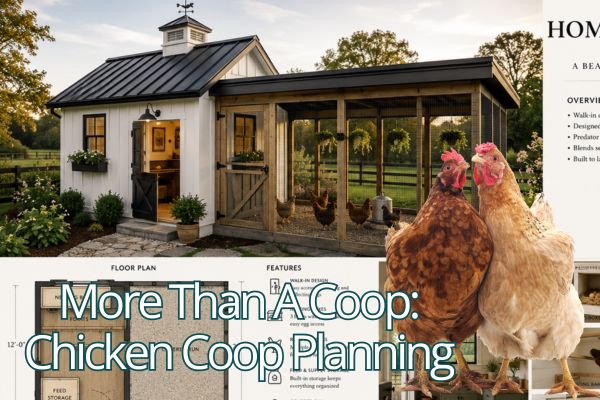
More than a Coop: Chicken Coop Planning
More Than a Chicken Coop: Choosing a Coop That Supports Health, Stewardship, and Home
There’s something deeply satisfying about collecting fresh eggs from your own backyard.
Maybe it’s the slower pace. Maybe it’s the connection to creation. Or maybe it’s simply knowing where your food comes from. Whatever draws you to keeping chickens, one thing becomes clear very quickly: choosing the right coop matters more than choosing the chickens.
At Storehouse Wellness, we often talk about creating environments that allow us to flourish. Just as our bodies thrive when we nourish them well, chickens thrive when they are given a safe, healthy environment designed with intention.
The coop isn't just a shelter—it becomes the foundation for your flock's health, your enjoyment as a homesteader, and even the beauty of your property.
Start with Your Purpose
Before buying or building a coop, ask yourself a few questions:
Are you raising chickens primarily for fresh eggs?
Do you hope to occasionally raise meat birds?
Is this simply a hobby, or do you envision expanding your homestead over time?
Do you want a functional structure—or something that becomes a beautiful extension of your home?
For many families, eight to ten laying hens provide an excellent balance of fresh eggs without becoming overwhelming to manage. If you occasionally want to raise meat birds, those can often be added seasonally in a separate area without changing your permanent setup.
Mobile or Stationary?
Both options have advantages.
A mobile coop (sometimes called a chicken tractor) allows birds to forage on fresh pasture and naturally fertilize your land. These systems work well for smaller flocks and people who don't mind moving the coop regularly.
A stationary coop offers greater convenience, stronger predator protection, and the ability to create a beautiful, permanent structure. When paired with rotational pasture areas, you enjoy many of the benefits of free-ranging without sacrificing security.
For most families, a hybrid approach offers the best of both worlds:
A permanent, walk-in coop
A secure covered run
Rotational pasture paddocks that can be opened as conditions allow
This provides flexibility while keeping your flock safe from predators.
Build for Your Climate
In Tennessee, our biggest challenge isn't usually winter—it's summer heat.
The ideal location allows the coop to receive morning sunshine while enjoying afternoon shade. Morning sunlight helps dry overnight moisture and encourages laying, while afternoon shade helps reduce heat stress during our hottest months.
A covered run becomes especially valuable because it gives chickens a comfortable place to spend time regardless of weather.
Don't Underestimate Predator Protection
One of the hardest lessons new chicken owners learn is that predators are persistent.
Coyotes, raccoons, foxes, hawks, and neighborhood dogs all view chickens differently than we do.
Instead of relying on traditional chicken wire, consider investing in:
½-inch hardware cloth
Secure latches
A buried predator apron around the run
An automatic coop door
A fully enclosed covered run
These investments may cost more initially but often save countless headaches—and heartbreak—in the future.
Think Beyond Function
One of our favorite ideas is to stop thinking of a chicken coop as an outbuilding.
Instead, imagine building a tiny garden cottage.
Picture white board-and-batten siding, a black metal roof, flower boxes beneath the windows, charming exterior lighting, and a stone walkway leading to a welcoming front porch.
A thoughtfully designed coop becomes part of your landscape instead of something hidden behind the barn. It adds beauty to your property while creating a place you'll genuinely enjoy visiting each day.
Stewardship Begins at Home
Genesis reminds us that humanity was entrusted with caring for creation.
That stewardship extends beyond the food we eat—it includes how we care for the animals entrusted to us, how we use our land, and how intentionally we create spaces that reflect excellence and care.
Whether your homestead includes two raised beds or twenty acres, every thoughtful decision becomes an opportunity to honor that calling.
A well-designed chicken coop isn't simply a place for chickens to sleep.
It's a place where children gather eggs before school.
Where quiet mornings begin with a cup of coffee and the sound of contented hens.
Where neighbors stop to admire a beautiful little cottage and leave inspired to begin their own journey.
Sometimes wellness begins with the simplest choices.
Sometimes it starts with building a home for a few chickens.
And sometimes those small acts of stewardship become reminders that God often grows extraordinary things from faithful care of the ordinary.
Storehouse Wellness Tip: If you're planning your first coop, consider designing it slightly larger than you think you'll need. You'll appreciate the extra room for feed storage, cleaning, seasonal additions, and simply enjoying time with your flock. Thoughtful planning today can provide years of simplicity, beauty, and abundant fresh eggs.
